Monday, April 28, 2014

Venice's Gondoliers Row for Research

Regata dei Traghetti for the Fondazione Umberto Veronesi

 Criticism has been laid on the gondoliers' strong broad shoulders as far back as when they began rowing down Venice's beautiful canals. Comments which are often heard spoken in dialect by fellow Venetians—their most ardent critics or printed in the local press and more recently on social networks. Now, with the variety of instant communication sources, it’s no surprise that when a gondolier makes an error the world takes notice, too. Granted some critical comments have been warranted, others not so much and most are brought on by a minority of the 400-plus strong category. However, as with any group that works in the public eye, it is
Getting ready  
quite difficult for the majority of the gondoliers who abide by the rules to escape judgment based upon the actions of a few. Therefore, I think when all 400-plus gondoliers make a grand, generous and straight from the heart gesture that it is only right and proper to commend and applaud them.


Last Friday, April 25, 2014, the Association of Gondoliers dedicated their annual Regata dei Traghetti (a regatta between the 10 gondola stations) to the Fondazione Umberto Veronesi, a prominent and effective non-profit medical research foundation in Italy.


Not only did the gondoliers compete while wearing a striped t-shirt with the words Io Vogo per la Ricerca—I Row for Research—they pledged €30.000 (approx. $42,000) to fund the foundation’s “Gold for Kids” project. A first! Because in the ten years since 
Foundation supporters follow the regatta
the foundation began raising funds for cancer research, this is the first time one group has made such a large lump-sum contribution. It may also be the first contribution to go towards the foundation’s new “Gold for Kids” project which supports the most innovative pediatric oncology therapies and medical treatment available to children being cared for in hospitals throughout Italy.

The first place winners: Traghetto Molo/San Marco


The relationship between the Fondazione Umberto Veronesi, one of Italy’s most respected non-profit organizations, and the Gondoliers, the symbol of one of Italy’s most beloved cities, brings an exemplary initiative to life. A noble gesture that comes from the hearts of what I personally consider to be a noble group of people—a gesture that I hope might serve as an example for other associations, groups and individuals to follow.

Un grande grazie di cuore ai gondolieri di Venezia!


Tuesday, March 11, 2014

Pharrell Williams' Happy has made it to Venice!


Italy to Los Angeles and Back 

thought this might bring a smile to all who love Venice! 

Pharrell Williams' Happy 

Danced to in Venice!


Thanks to:

HostelsClub 

Happy in Venice Video


Watch it here!


Tuesday, February 25, 2014

A glimpse of Carnevale Venice 2014


Masks-Carnevale 2014
Traghetto Molo, San Marco


Carnevale, for many who live in or around Venice, is a time when you either stay away from St. Mark's square and the crowds that fill the city's only piazza or you wait to view the marvelous costumes and masks on an 'off day'. 

This year the festivities officially opened on Sunday February 23rd with the traditional Volo dell’angelo or Flight of the Angel. It was reported that 105,000 people attended. I, intentionally, was not one of them.


A beautiful mask, Venice 2014
The origins of the Angel, interpreted in the 1500s by a Turkish acrobat and known then as the Svolo del Turco, now stars a selected damsel dressed in costume who, securely belted to a robust pulley, slowly descends from the ledge of the bell tower, over the crowd, and into the welcome arms of the honorary Doge awaiting her on stage at the far end of the square. Over the centuries the Flight of the Turk became known as the Flight of the Angel, until a tragic accident in the mid-1700s caused the human Angel to be replaced by a Colombina (dove) carved from wood. La Colombina remained the opening Carnevale attraction until recent years. In fact, the first few Volos I attended in the late 1980s, and if my memory is correct into the 1990s, were indeed la Colombina. Many Venetians still refer to the opening Carnevale ceremony as il Volo della Colombina. However, some years ago, thanks to modern day safety techniques, the more exciting descent of a ‘real’ Angelo has, once again, returned. 


Court Jester
However, as I stated, I stayed away and instead chose, as I've done for more years than I can remember, to take a walk through Venice's back alleyways on Monday, a quieter Carnevale day. Of course, I ended up in St. Mark's square-- which around our home is also known as my husband's office. 

While waiting for my dear husband to mettere la barca da notte (put the gondola away for the night), I snapped these photos. I hope you enjoy them as much as I do. 


My favorite this year. 


Saturday, February 1, 2014

10 random things Italy has taught this native Southern Californian...


Today marks 27 years since I left Los Angeles and moved to Venice, Italy—a lot of changes have occurred in my life, on the inside and out. So, just for fun, I’d like to share a few of the random things Italy has taught this native Southern Californian:

Piazzetta San Marco, Venice


  1. Walk or take public transportation. They’re easy options that help your wallet, waistline and the environment.
  2. Unless there’s a deadline, it’s okay if you leave it for tomorrow.
  3. Traditional Italian lasagna is made with besciamella cream sauce and lots of Parmigiano cheese, not mozzarella.
  4. Neighborhood clock towers and church bells are great time telling instruments.
  5. As an alternative, a scoop of fresh gelato makes a healthy summertime meal.
  6. No other country designs and makes shoes, handbags or clothes like Italy. No, not even France!
  7. Stop an average Italian on the street and he or she will probably know more about the world’s current events than an average U.S. citizen—even when it comes to U.S. foreign affairs.
  8. Wine or water, and sometimes beer, are the only beverages that should be consumed with food.
  9. National Healthcare works well for everyone.
  10. No matter how trying the economy, how disorganized the government, Italians resiliently move forward and, somehow, make life work.


Tuesday, December 24, 2013

Buon Natale from Italy to Los Angeles and Back

Merry Christmas to all...

Buon Natale a tutti


and

Thank You for following 

Italy to Los Angeles and Back


Thursday, October 24, 2013

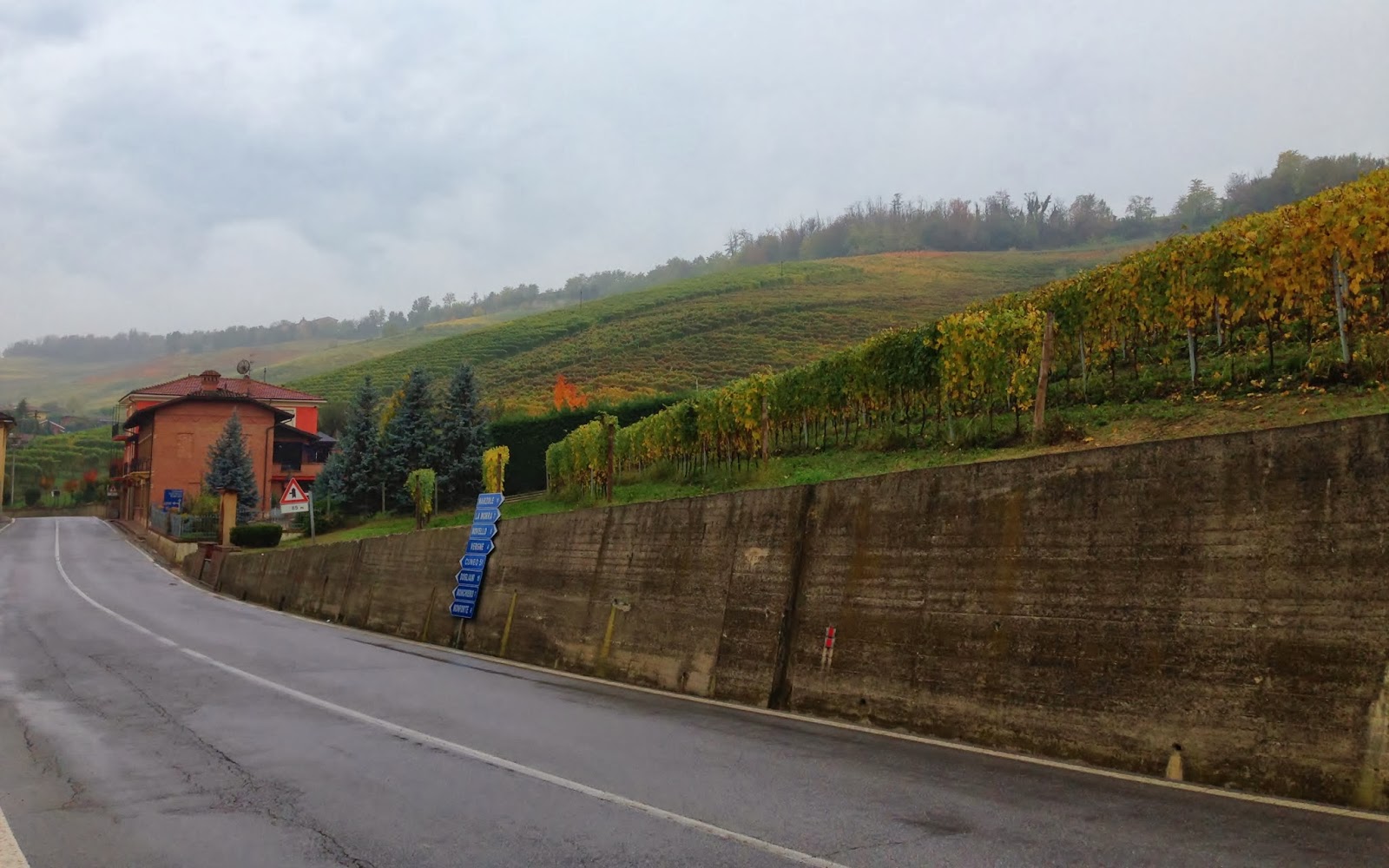
Twenty reasons why you'll want to visit the Langhe in Piedmont, Italy.


1. Travel the 'Strada Romantica' through the sweet rolling hill sides of Barolo.


2. Eat fresh white truffles at Cascina Collavini: http://www.ristorantecollavini.it/ 

 
3. Stay in elegant surroundings like the Relais Poderi Luigi Einaudi  in Dogliani. http://www.relaiseinaudi.com/


4. Call a country home, home.
5. Watch autumn colors wash over Dogliani.
 
6. Enjoy a splendid view from a splendid room.


7. Learn about and taste local wine.
8. Warm up in a sitting room that was once a stable.
 
9. Use a barrique as a table.


10. Indulge your senses in a plate of homemade gnocchi and fresh sliced white truffles.

11. Swim in a wine-bottle shaped pool.


12. Wander down country roads.
13. Enjoy breakfast in peaceful surroundings.


14. Gaze at the view from the top of Neive.

15. Wonder at nature's ability to astound.

 
16. Visit wine cellars in use since the 1800s.

17. Travel toVerduno and eat where the locals do: http://www.bercau.it/ 

18. Prepare a light dinner with local fruit, wine and cheese.

19. Look up in Neive and see a grape covered balacony that would make Juliette jealous.

20. Say arrivederci to Barolo because you'll surely return.

  Where are the Langhe?  http://en.wikipedia.org/wiki/Langhe  Buon viaggio!


Friday, October 18, 2013

Sarah Mastroianni, journalist for Canada's Panoram Italia magazine, asked me what I thought...


Venice’s Struggle for Survival

2013/10/11 - Written by Sarah Mastroianni
Venice’s Struggle for Survival
SHARE THIS ARTICLE
ShareThisGoogle +LinkedInPinterest

Throughout the course of its lengthy history, Venice – the city on the water – has  become home to innumerable artistic, architectural, and cultural treasures, as well as  historical figures such as Marco Polo, Antonio Vivaldi and Giacomo Casanova. But  despite the city’s illustrious past, present-day Venice is in trouble. It’s only fitting that  such a unique city should face an equally unique array of problems. The rising water  levels, increasingly frequent occurrences of “acqua alta,” sinking foundations, a falling  local population and ever-increasing throngs of tourists, have the city both literally and  figuratively fighting to stay afloat.    
Add caption
 
Marie Ohanesian Nardin, writer of the blog Italy to Los Angeles and Back and  long time resident of Venice, weighs in on the city’s water-related struggles,  commenting, “All too many times a year Venice’s residents must deal with  high tide invading ground floor homes and entryways, their shops, restaurants and  schools. They must prepare for such, and though the high tide may entertain tourists,  it is no light matter for the locals.”    
It’s during these times that sirens sound a warning throughout the streets and  locals can’t do much except wait for the high tides to abate and hope that the damage  is minimal.                              
“But Venetians are resilient people,” Nardin continues, “and take living with high  tide as part of their culture; they just wish it didn’t happen so often.”  It’s looking like Venetians might actually get their wish.                          
The aptly named Progetto MOSE (Modulo Sperimentale Elettromeccanico),  which is currently in progress, is expected to accomplish in Venice what Mosè (Moses)  did in biblical times: save the people from the water around them.                
How will it reach its goal? The Progetto MOSE, governed by the Consorzio  Venezia Nuova, consists of a series of electromechanical gates, which are being  installed underwater at the three mouths of the Venetian lagoon: Chioggia,  Malamocco and Lido. The gates will exist to effectively close off the lagoon from the  sea during high tides or extraordinary weather conditions in order to prevent the  water level from reaching dangerous heights within the city’s canals.

Clara Ceolin, Cultural Coordinator at the Centro Veneto in Toronto, was born  on the Lido and returns to Venice regularly with her family. On a recent trip she visited  one of the MOSE construction sites to get a better idea of just how a man-made  machine might be able to “fermare il mare,” (stop the  sea). “They’ve been working on it for years,” says  Ceolin, “but they had problems with money.”                
After many years of planning and numerous setbacks  along the way, the project is currently more than  60 percent completed. The much-anticipated MOSE  should finally become operational sometime in 2014,  but there’s still a catch.                      
“There are many people who say that it won’t be  useful at all,” reports Ceolin. Unfortunately, this might  actually be true: there is still much speculation as to  whether the gates will actually be capable of living up to  their purpose, since, to date, a project of this kind has  never been used in any other comparable situation in  the world. Despite the widespread worry, “We have a lot  of hope in the project,” she says.
But Venice’s water level issues aren’t the only ones  that make it an increasingly difficult place to live.  “The Venetian people feel their city is slipping  from their fingers and being monopolised by a tourism  industry that both provides the livelihood of many  locals and strips the city of the quality of life that only  Venice can offer,” Nardin says.                        
The love/hate relationship that Venetians have  with tourism is a complex one, not caused by one element  but by a combination of issues that negatively  impact the daily life of those who reside in the city. On  a very simple level, Venetians don’t appreciate the flood  of visitors – upwards of 9 million in 2012 – who, at  times, lack respect for their city and treat it as if it were  an amusement park instead of home to real people with  jobs, lives and families.
As if that weren’t enough, Nardin explains that  the cost of living in Venice is very high, with average  household spending in the Veneto reaching 2835 euros  per month (the third highest of Italy’s 20 regions), a  number which is being driven higher by the ripple  effects of the city trying to cater to millions of tourists.  Unable to make a living or enjoy their city, many locals  are leaving Venice in search of work and respite from  the flooding that assails their city, both in the form of  tourists and high tides. In 1961, there were 137,150 residents;  the number dropped to 58,991 in 2011.                        
What future is there for Venice with all her problems?  Similarly to Ceolin, Nardin has hope for the  Progetto MOSE and reaffirms her love for the city,  tourists and all. “Being in Venice is living in history:  when I step through her calli (alleyways), I can’t help  but wonder about those who have followed the same  route for centuries before me. And for someone like me  […] Venice will always be home.”

- See more at: http://www.panoramitalia.com/en/arts-culture/history/venice-s-struggle-survival/2163/#sthash.CAsKkuUO.dpuf