Thursday, August 18, 2011

Venetian Gondolier to Sail the Atlantic...all Baimaiself...all by myself!

In the more than two decades that I have lived in Venice I have met many Venetian men and women who are passionate about boats and the sports surrounding them. Yet none have impressed me as much nor do I consider them to be as daring and determined as 35 year old gondolier by profession and sailor by heart Tommaso Luppi. 

Tommaso Luppi aboard Baimaiself

When being greeted by his sincere handshake and warm smile what one quickly notices about Tommaso is that his eyes are as blue as the Atlantic Ocean; that vast body of water he is set to sail across this November—all alone. The vessel he will command on the 23-25 day journey from the Canary Islands which sit off the Northwestern coast of Africa to the island of Martinique in the Caribbean Sea is a 32 foot Moana sailboat appropriately named Baimaiself…the Italianized pronunciation of by myself.
The moment I heard about Tommaso’s adventure the romantic impulses in my brain bounced around images of a young, contemporary Venetian gondolier bewitched by desire to raise the sails to the wind and call upon experience and an inborn sense of adventure to challenge and conquer the second largest ocean on earth while succumbing to the same passion that had possessed his fellow countrymen Marco Polo and Christopher Columbus. But the logical side of my brain battled with those thoughts and wondered: Why? What pulls a man to want to accomplish such a treacherous feat alone? I had to meet Tommaso and get some answers.
Then on a warm summer evening Tommaso, his lovely wife Sara and their charming eight-year-old daughter Matilde—one-year-old Camilla stayed home with I nonni—joined my husband and I for dinner at a bustling pizzeria in Campo San Polo. Between bites of bubbling hot pizza and above the sound of Robert De Niro’s voice booming from the nearby cinema all’ aperto, Tommaso calmed my curiosity with his deep sense of serenity and reflection, proving he has left no stone unturned in preparation and thought for his journey. This is what he so kindly revealed to me so I in turn could share it with you:

       Marie:  How long have you been a gondolier, and how long have you been sailing?
        Tommaso:  I’ve been sailing since 1994, and working as a gondolier since 1999. Becoming a gondolier seemed logical to me because it intertwines with my passion for the sea.

        Marie:  A gondolier mans and masters his own boat, is it the same for you when sailing?
        Tommaso:  A gondolier rows a gondola alone however we are always surrounded by tourists, colleagues and friends, while at sea it’s different. Out there you are all alone and the sense of freedom one feels is incredible; there’s a sensation of being part of nature, and maybe one can say that primitive senses emerge. I think these same emotions are impossible to experience in situations we face in our everyday lives.

Marie:  Why make the journey alone?
Tommaso:  Simply because I have always imagined and dreamt about making my first “crossing”   alone; it’s hard to explain but it’s something I feel deep down inside.

Marie:  Have you made other journeys alone?
Tommaso:  Yes. My very first journey alone was in 1994, the same year I began sailing. I crossed the Adriatic Sea from Venice to Rovigno, Croatia.  At the time I was sailing my first boat which was 5.5 meters, approximately 18 feet. Since then I’ve transported boats for work or for friends, often taking them to various sites for regattas enabling the crew to arrive rested and ready for their race.

Marie: Why have you chosen to follow in the “footsteps” of Christopher Columbus one of Italy’s most famous sons?
Tommaso:  Navigating across the Atlantic by sailboat and following the route of Christopher Columbus is every sailor’s dream. At least it’s been mine since I was a child. Columbus’s voyage has always fascinated me and I’ve imagined myself onboard his caravel. However, it must be said that the route the Admiral followed is the most logical because it taps into the Alisei or the East North East trade winds. For centuries these trade winds have accompanied sailing ships on Atlantic crossings between the months of November and January.

Marie:  Where and when will you begin your journey?
Tommaso: My departure is scheduled for September 1, 2011 from Gibraltar where Baimaiself is now docked. From there I’ll head to the Canary Islands assisted by the Portuguese Alisei—trade winds—which blow in that period. Then, on November 16, 2011, I’ll set sail from Gran Canaria and after 24 days and approximately 3000 miles of nothing but ocean I’ll arrive in the Caribbean island of Martinique where my wife and two daughters will be waiting.

Marie:  What is your favorite part of sailing the seas alone?
        Tommaso:  Other than the beauty and magic of watching your boat navigate day after day and being able to feel that you are one with nature, it’s also an internal journey.  Perhaps it’s a quest for something ancient that everyday life keeps from us. But more than anything else sailing alone is freedom without borders; living by instinct.

Marie:  Why are you ready now, at this time in your life, to make this journey?
Tommaso:  I’ve prepared each and every boat that I’ve ever had with the idea of making a transatlantic crossing, but often they turned out to be insufficient for such an endeavor, therefore I had to start over. I’ve also had other priorities in my life like my home, my children and various unforeseen situations, and there has always been a lack of funds. So here I am today ready to realize my dream, even though I believe with the proper boat I would have been able to attempt this undertaking as far back as 1994.

Marie: Beside your passion for boats and sailing what other aspects of life have prepared you to take on such an arduous journey?
Tommaso:  I believe, other than my own technical preparation and that of the boat, in order to be able to cross the ocean alone on a journey that you have planned without any assistance you need a great amount of internal motivation which goes far beyond any other sort of technical preparation. I truly believe certain qualities needed to face this type of challenge either are or are not a part of a person’s character.

Marie:  How will you stay in contact with land/family while on your journey? And how will the boat be navigated when you sleep?
Tommaso:  Thanks to modern technology, unlike sailors of another time, I have a satellite telephone which if necessary will permit me to call from any part of the world. I plan to keep my Facebook page up to date so I can communicate with friends about my progress with the crossing, and again thanks to satellites whoever may want to can send me a free text message to my onboard telephone; something that is always a pleasure to receive and is also very encouraging. And the boat will be controlled by Mustafà, who isn’t a stowaway, but a marvelous and simple wind rudder; in other words a steering mechanism that permits you to maintain the route with respect to the wind angle. So if I’m going west and the wind comes from the north, by regulating Mustafà in the direction of the wind he makes the boat go west. In any event, when you navigate alone there’s not a lot of time to sleep. So I’ll be taking short 15 minute naps within brief but repeated intervals because 15 minutes is the length of time that a ship which is out of sight can appear over the horizon and still allow time for any needed maneuvers.

Marie:  What thoughts do you expect will go through your mind when you see the island of Martinique?
Tommaso:  That’s a good question! I imagine when I arrive and see the Caribbean I won’t only realize that I have crossed the Atlantic and accomplished my endeavor, but it will be the end of a dream that has continued for 17 years. At the moment I can’t give a clearer answer. I think it’s something that has to be lived, but I’ll be happy to let you know when I arrive!  

Marie:  As a good hearty eating gondolier, what food/drink will you not go without while on your journey?
Tommaso:  Without a doubt I’ll have lots and lots of pasta, which of course is my favorite dish! But I must confess I’m not a great cook, so I’ll also use some freeze dried foods especially when there are sea swells. And I’ll certainly supplement my diet with freshly fished seafood.

Marie: What are your sailing plans after the Caribbean, onto other harbors?
Tommaso with daughter Matilde
Tommaso:  My wife and two daughters will be waiting for me and we will sail around the Caribbean for about two months, reaching each and every island. Then my boat will be shipped back to Genoa, Italy where I’ll circumnavigate all of Italy trying to touch each region and principal city until I reach Venice and St. Mark’s square, where friends and family will be waiting to celebrate.

Marie:  Do you have sponsors, and are you looking for more?
Tommaso: Up to now I have a few sponsors who have assisted me in purchasing supplies, but I’m looking for others to help me bring Baimaiself back to Italy. All sponsors will have their logo on the boat for the entire voyage and until she is safe in harbor back in Venice.

In closing I want to send my best wishes to Tommaso for a safe voyage and thank him for letting me feature his adventure on my blog. I invite you all to join me right here over the next few months as I bring you up to date on his Atlantic crossing.

And I am honored to add Italy to Los Angeles and Back www.italytolosangelesandback.blogspot.com to the following list of sponsors:


You, too, can sponsor Tommaso Luppi’s transatlantic adventure
Follow him on
at http://www.baimaiself.com/
And watch him on YouTube


Baimaiself


Sunday, July 17, 2011

Il Redentore...a night you might want to add to your bucket list.


I don’t want to make this post about the history of La Festa del Redentore—the Feast of the Redeemer—other than to say that it is a deeply felt Venetian holiday held every year on the third Saturday & Sunday in July to commemorate the end of a terrible plague in 1576. For more you can click on the Wikipedia link at the end of the post. Instead, I’m going to attempt to retrace my magical evening and bring you along.

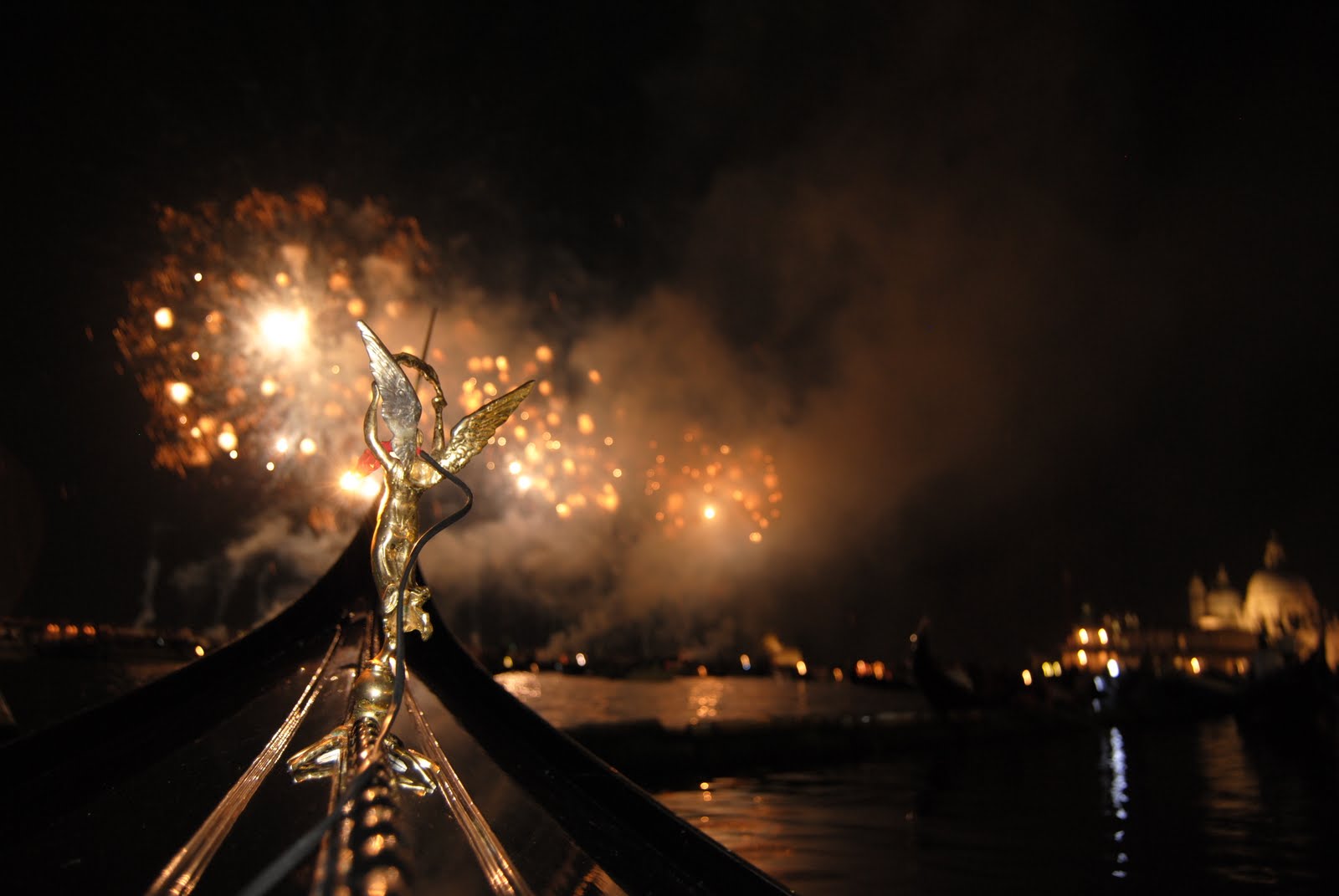
Il Redentore 2011 a View from "Maria"
It all began when I found out that my husband—many of you have learned through my blog that he is a gondolier—wasn’t scheduled to work this year on the night of Il Redentore. I quickly—and not so subtly—began to hint: Amore…wouldn’t it be nice to go see the fireworks in the gondola? Mind you we have done this many times in the past, but since his work schedule must take precedence I haven’t witnessed this spectacular show for at least four, or maybe even five years now.  Being in the midst of his very busy season and not particularly anxious to battle a crowd of one or two-hundred thousand people on his day off, he hemmed and hawed before conceding with a shrug of his shoulders and a proclamation of happy wife, happy life.

Reflecting Redentore
Our evening was blessed right from the start: The rain clouds that had been hovering above in the late afternoon had gone elsewhere and left us with a balmy summer evening; a rarity in a town where high humidity commands the weather front. We took the short train ride from our countryside neighborhood to the Santa Lucia train station in Venice, and were accompanied by two dear friends who were excited to see Maria moored just a bridge away from the station. In order to avoid the crowds my husband had made a special trip to town in the morning, yes on his day off, to row his beloved gondola from the traghetto in St. Mark’s square and leave her at the traghetto in front of the train station; making it easy for my lady-friend and I to step off the train in high-heeled sandals that we would normally avoid wearing to Venice, but were happy to slip on knowing we only had to take a few steps to our gondola.

The Grand Canal was bustling with activity: Vaporetti, water-taxis, gondolas and private motor boats splashed by and were filled to the brim with spectators headed to find their space among the crowd in the Piazza or along the St. Mark’s basin waterway. But another three hours would have to pass before the fireworks began, and we had a dinner detour to make.

We left the Grand Canal and turned down the lesser travelled labyrinth of inner waterways that crisscross the Canareggio neighborhood. After a couple of twists and turns and lots of oohing and awing at sights one only seems to discover from the angle of a gondola we approached my favorite restaurant in town: Osteria L’Orto dei Mori—the Moors’ Vegetable Garden Inn. Micael, partner-owner and highly qualified sommelier, greeted us canal side, but before escorting us to our linen clothed table in the middle of Campo dei Mori he jumped onto his nearby docked motorboat and tossed a couple of rubber boat fenders to my husband to tie along the side of Maria to protect her from the rugged marble and stone foundation. That done we followed Micael into the quiet neighborhood campo named for four 13th century statues. The Moors (though some historians say their dress is Greek) stand guard on the sides and corner of the building that is now the home of this fine osteria and which just so happens to abut an even more famous building; the Venetian Renaissance—16th century—painter Jacopo Comin’s former residence, commonly known as Tintoretto’s home. Though Venice is an open-air museum it still surprises me when I find three hundred years of history within a few square meters!

Once seated at our table, and while sipping our aperitivo of prosecco—the elegance of the evening called for us to stray from Spritz and turn to the bubbly—we listened as Micael made suggestions and began to serve delicate plate after plate of appetizers, pasta, gnocchi and fresh seafood; all prepared by Lorenzo, founding partner and co-owner of L’Orto dei Mori, whom I consider to be one of the finest chefs in Venice. Again, I won’t go into detail about their exquisite and well prepared menu, but please trust me; you should certainly try this fine restaurant on your next trip to Venice.  

Light in the Lagoon
The good company, fine food, and in all honesty a little too much wine, made us lose track of the time. So when we realized that within minutes the fireworks would begin we jumped back in the gondola and headed toward St. Mark’s square.

My husband was making good time when we entered the Grand Canal, only this time we were the only ones there. Now for those who have never been to Venice, this might be a bit difficult to imagine and I’ll try to do the scene justice; for those who have visited Venice you understand what a rare experience this is. There were no vaporetti, motor boats or water-taxis making waves, or noise, there wasn’t even another gondola; just Maria quietly slicing through the reflection of grand palaces. We were all alone, and had one of the most beautiful spots in the world all to ourselves. It was a magical moment and we realized, right then and there, that we were living an unrepeatable experience.  

Then boom! Our attention was jolted from the surreal surroundings and up toward the sky where just beyond the Rialto Bridge flashes of red, white and green towered above Venice in a tribute to Italy’s 150th anniversary of unification; the show had begun. My husband rowed faster and soon Maria was slipping beneath the Bridge of Sighs and out into St. Mark’s basin where we joined thousands of others by tilting our heads up to admire the splendor of Venice silhouetted by a glittering display of light.  


Osteria L’Orto dei Mori: http://www.osteriaortodeimori.com/

Monday, July 11, 2011

You know it's summertime in Italy when...

      ….you stroll into a sunbaked campo and spot a group of gray-haired women sitting in the shade snapping the tips off freshly picked string beans and listening to the sound of Enrico Caruso billow through the curtains of a nearby window.

….after dinner your neighborhood gelateria has a blockbuster-like line out the front door.

….colorful preprinted fill-in-the-date cards with the words Chiuso per Ferie da….a…. (Closed for Vacation from….to…..) pop-up in storefront windows all across town.

….big-rig trucks disappear from the autostrada and cruise ships appear at the port.

….clusters of green fruit drip from the vine patiently waiting to be sweetened into red or gold.

….the fresh basil in your garden begs to become pesto.  

….even those who have never heard of pilates, yoga or Technogym brave their bathing suits and enjoy the sun, sand ‘n sea.

….the real definition for hot fashion strays from Paris Hilton’s use of the word and goes back to the classic linen sundress, an elegant handheld fan and a broad-brimmed straw hat.

….the locals leave the cities to the tourists and head to their beach or mountain homes.

….you gladly share the name of your favorite restaurant in town and make a list of things-to-do for vacationing family and friends because you want them to love the magic of Italy as much as you do!

Monday, July 4, 2011

Top Ten Reasons to Celebrate Independence Day in Italy!

1.      You make grandma’s famous potato salad and no one scolds you for using mayonnaise instead of olive oil.

2.      You give a little history lesson to your neighbor after he sees you putting up the American flag and asks if the U.S. is playing Italy in a soccer match.

3.      Your Italian friends concede when you say “as a republic my country is older than yours”.

4.      You finally find some use for all those little American-flag toothpicks you bought on your last trip home.

5.      You pick up a six-pack of Budweiser instead of the more fashionable Peroni just because it’s Made in the U.S.A.

6.      You convince your local greengrocer that corn was meant to be eaten on-the-cob.

7.      You prove to your Italian friends that hamburgers and hot dogs can be yummy slow-food, too!

8.      No one dares to argue when you turn-up the volume on Springsteen’s Born in the U.S.A.!

9.      Your Italian friends make you smile with a Happy 4th of July greeting sent via Facebook

10.   Because you’re proud to be an American even if you live abroad!

Happy 4th of July!!!
Take a moment and go to the right side of my blog to “LIKE” Italy to Los Angeles and Back on Facebook and follow me here and on Twitter
Thank you!


Tuesday, May 31, 2011

Pizza, politics and pick-pockets…

L'ora dello Spritz...Aperol o Campari?
Dorosoduro’s Campo Santa Margherita is the spot to be on a warm, starlit pre-summer evening in Venice; and last night the hustle and bustle of people filling the popular meeting place showed no exception to that rule.
In and around Venice, a before dinner get together is known as l’ora dello Spritz or Spritz Hour—the local equivalent of Happy Hour. Lifting a glass—complete only if topped off with a large green olive or an orange twist and often both—has become a ritual which is as much a part of Venetian life as sipping a morning cappuccino at the corner bar or stopping in at the local bakery before noon to make sure you get your pick of the day’s freshly baked bread.
Last night I shared my spritz experience with a wonderful group of American expats who—if I quickly pull together an average—have each lived in Venice for more than a decade. After two hours of political chatter—yes we do still care about what happens in our homeland— and thirst quenching that left our brains stimulated and the bottoms of our drinking tumblers red or orange depending on the choice of Campari or Aperol, we left the bar’s jasmine scented garden, shook each other’s hands, double-cheek kissed and shouted Italian and English salutations into the cool night air. Some headed home, one went to the gym, and a smaller group of us answered the not-so-quiet rumble in our stomachs by strolling into the heart of the campo and occupying a table in one of the half-a-dozen al fresco dining trattorie that frame the area.
We were cordially greeted by the restaurant staff, ordered our meal and continued a more intimate conversation about our lives, hobbies and professions making the pleasant discovery that our small dinner group consisted of a combination of wonderful teachers and writers.  Before long we were once again sipping drinks, cutting into artichoke and cheese pizza and satisfying our taste buds with the respectable Italian version of an American Club Sandwich.
Rarely at a loss for words, I did my share of talking, yet what I enjoyed most of all was listening to my new friends. I sat back to contemplate the unrelated events that had touched each of our lives and had brought us to Venice; I liked the idea that these same circumstances were giving us the opprotunity to forge new friendships which otherwise might have been missed had life placed us elsewhere.
The evening rushed ahead and our thoughts turned to trains to catch, early morning appointments, and my husband who was waiting for me in St. Mark’s square after a long day at work. The conto came and as we all reached for our wallets the joy that had wrapped its arms around our lovely evening vanished.  We were given a swift shove back to the unpleasant side of reality when one of our friends discovered that while we were enjoying each other’s company, someone else had unzipped her purse, reached inside and stolen her wallet; apparently it was one of the two men who had been seated at the table behind us, and had opened and closed their menus only to quickly leave without ordering.
What to do...except make the fact known to the restaurant owner and report it to the Carabinieri? That done my dear friend had to face the tiresome task of cancelling credit cards, reporting her stolen identification and local transportation passes, and try to overcome the gut wrenching displeasure of having been robbed.
I’d like to believe that these things can’t happen in this beautiful city; but they do. The genuine sense of security and ownership that one quickly feels when in Venice can betray the visitor as well as the resident. The feeling of being part of a neighborhood is exactly what makes it easy for the work of pick-pockets to go unnoticed.  My comments are not meant to frighten or criticize, but instead are meant to remind all that in the majority of touristic cities in Italy and around the world this is not only the high tourist season but also the time of year when pick-pockets do their best business. On the street, in crowds, on the vaporetti and especially while seated in cafés, restaurants and bars keep your purse zipped and in front of you or your wallet and cash in your front pocket. You’ll keep the bad guys a little more honest, and save yourself from remembering a lovely evening in a beautiful campo as an unpleasant experience.

Tuesday, May 3, 2011

Valpolicella: a canter away from Venice


Serego Alighieri vineyards-Valpolicella,Veneto
 
The grapes becoming Amarone & Recioto

I'd like to give those of you who have already visited this blog article or those of you who are stopping by for the first time an update based on my recent return visit to the Serego Alighieri vineyards. It's October 2011 as I'm writing and yesterday I was fortunate to see this year's harvest of grapes laid to rest on their bamboo beds.  I've added a few photos to give you a better idea of how the passimento process works to produce the wonderfully rich flavors found in Amarone and Recioto wines. And, just between you and me, the insiders say 2011 will be a very good year...let's hope so. Enjoy, and read on 
Grapes laid to rest of bamboo beds
!

Even for those who have never set a heel at the top of the boot the mere mention of travelling to Venice, Italy instantly brings to mind the images of stripe-shirted gondoliers navigating their black vessels down the Grand Canal; a multitude of mazelike alleyways dotted with Carnival-mask and Murano glass selling storefronts; or Renaissance palaces reflecting on the canals they seem to float upon. But what about those other worthy places that are rarely explored or left to that wishful second or third trip? Seasoned travellers know that after you’ve immerged yourself in the beauty that Venice has to offer, a day or two spent discovering the quiet corners of the Veneto region is a side trip you won’t regret.
VALPOLICELLA: Rich, intense, seductive earthiness, raisinated taste yet not sweet…that’s the description that comes to mind when one speaks the word Valpolicella and contemplates her wines. Set on the flatlands and hillsides of Verona and just a little over an hour’s drive west of Venice lies an area that the locals are proud to tell you has produced wine since as far back as the Ancient Greeks, and whose name is said to derive from the Greek Roman combination for Valley of Cells. Acres upon acres of grapevines—Corvina, Rondinella, Molinara—furnish the world with the ever-more-in-demand wine of the homonymous named valley. Bathed in the moist cool air that flows westward from the Adriatic Sea and eastward from nearby Lake Garda this fertile soil nourishes its vines and grants us its famous reds: Valpolicella Classico and Ripasso are the two younger yet noble siblings of the land’s more mature full bodied Amarone and smooth Port-like desert wine Recioto.
No visit to Valpolicella is complete without a stop at the enchanting grounds of the Serego Alighieri Vineyard. The property, owned by Count Serego Alighieri—a direct descendant of the 14th century poet Dante Alighieri—has been in the family since 1353. In collaboration with the well-known and respected MASI vineyards, and through online or telephone reservations, the Serego Alighieri winery is open to the public and offers informative tours with English speaking enologists whose gracious direction accompanies their guests down the hedge-lined paths of the estate, and through the grounds that nurture a select number of grafted vines dating back to the 1800’s. Once you’ve learned that in the 19th century grafting a pest resistant American vine with its European cousins saved most of Europe’s vineyards, you’ll climb up an old stone stairway to the loft where every October the grapes chosen to become Amarone, Recioto and Ripasso are laid out on bamboo beds for the appassimento; a drying process which can last up to four months. Back at the bottom of the stone stairway the guests enter a must scented cantina where cherry and oak wood barrels rest in the dim light, and leave their essence on the ruby red liquid they contain.  Further down a narrow hallway embellished with the Serego Alighieri family tree awaits the perfect ending to the enlightening tour: The wine tasting room where you can put your newfound knowledge to the test and savor a variety of Valpolicella, Ripasso, Amarone and Recioto on the spot, or purchase a bottle or two to take home.


Serego Alighieri Winery-Valpolicella
  

Guest House Serego Alighieri
For those who wish to prolong their stay in the sublime atmosphere of Valpolicella, the Serego Alighieri winery has tastefully decorated apartments named for the local grapes and housed in the estate’s wing adjacent to the winery. Reservations for the tour and accommodations can be made at:  http://www.seregoalighieri.it/ing/index.html

And for those who wish to make a day trip from Venice or Verona I highly recommend the Trattoria Dalla Rosa Alda in San Giorgio di Valpolicella, just up the hill from the winery where lunch on a vine covered terrace makes their scrumptious menu all the more desirable.  Guest rooms are also available in this quaint Bed & Breakfast. Reservations at: http://www.dallarosalda.it/e_trattoria.htm  
The winery is open year round but I think the best time to visit the Valpolicella region is from March through November. The wine harvest or vendemmia is in October, and the grapes are laid out to dry until mid-February. Salute!
Tasting the fabulous wines of Masi and Serego Alighieri vineyards

Friday, April 22, 2011

Liberation, a lion, a Saint, ham hocks and a rosebud…

San Marco-The Winged Lion

April 25th is a special day throughout Italy and  particularly in Veneto. Not only is it the anniversary of Italy’s liberation from Nazi fascism rule during World War II, it’s also the day commemorating Venice’s patron saint, St. Mark. San Marco, as he is proudly referred to around town, is represented in Venice as the winged lion, often holding an open book with the Latin inscription Pax Tibi Marce Evangelista Meus—Peace to You Mark My Evangelist. The regal lion can be found in the most conspicuous places around the city and region of Venice, and can still be seen carved into the historical walls of foreign ports scattered around the Adriatic and Mediterranean were La Serenissima—the Most Serene Republic of Venice once ruled.
How Saint Mark came to rest in Venice: It is said that in 828 A.D. due to the tension and the mercenary competition between La Serenissima and the Islamic regions to the south, the remains of Saint Mark were taken from Alexandria, Egypt and smuggled onto a boat stocked with pork meat. Not the most noble means of travel, particularly for a Saint, but quite an ingenuous idea on the part of two Venetian mariners—Bon or Good from Malamocca and Andrea known as Rustico or Rustic from Torcello. The shrewd captain and his first-mate knew that hiding dear Saint Mark among a bunch of ham hocks would keep the non-pork consuming Islamic customs agents from further investigating their cargo, and open up their nautical route back home to Venice, and a heroes’ welcome. In fact it is written that Doge Giustinian paid them 100 pounds of silver; a large sum that would enable them to finance the construction of St. Mark’s oratory on the island of Torcello, and become Venetian legends.
Il Bòcolo-The Rosebud
Il Bòcolo: Shakespeare couldn’t have written a better tale.
There once was a noble young woman by the name of Maria Partecipazio who fell fast in love with a kind, yet poor troubadour named Tancredi. Of course that didn’t sit well with Maria’s father. So one night while the two were having a clandestine rendezvous in her family’s gondola, Maria whispered the perfect solution into her handsome poet’s ear. Tancre, she syllabled quietly so as not to be heard by the family gondolier if you were to join the military and become a war hero then I’m sure my father would let you marry me! Well the poor guy was pretty smitten and knowing a troubadour made fewer ducats than a soldier he followed his true love's suggestion.
Before he knew it he was part of Carlo Magno’s distinct order and fighting the tough battle against the Spanish Moors. But, as all good tragedies go, he never made it back. What happened was that while he was fighting the good fight—apparently in a garden—he was injured and fell on a bed of white roses, turning them deep red. Minutes before he expelled his last breath he plucked a long-stem rose from the bush and handed it to his companion and fighter of the cause, Orlando. It took all the strength Tancredi had to ask Orlando to deliver the rose tinged with his blood to his beloved Maria.  
Soon after, Orlando arrived back in Venice; it was April 24th and the eve of the patron Saint’s celebration.  In keeping with his promise, Orlando delivered the rose to Maria along with Tancredi’s final message of love. Nowhere is it written, but it is understood that Maria was quite distraught for having sent the only man she loved off to war, and to his death. The following morning, on the 25th of April, the young noble woman was found dead with Tancredi’s rosebud placed upon her heart.
 From that moment on il bòcolo became the Venetian symbol to pledge one’s love and each year on April 25th thousands of maidens, young and old, are handed a long-stem red rose by their enamored knights.